
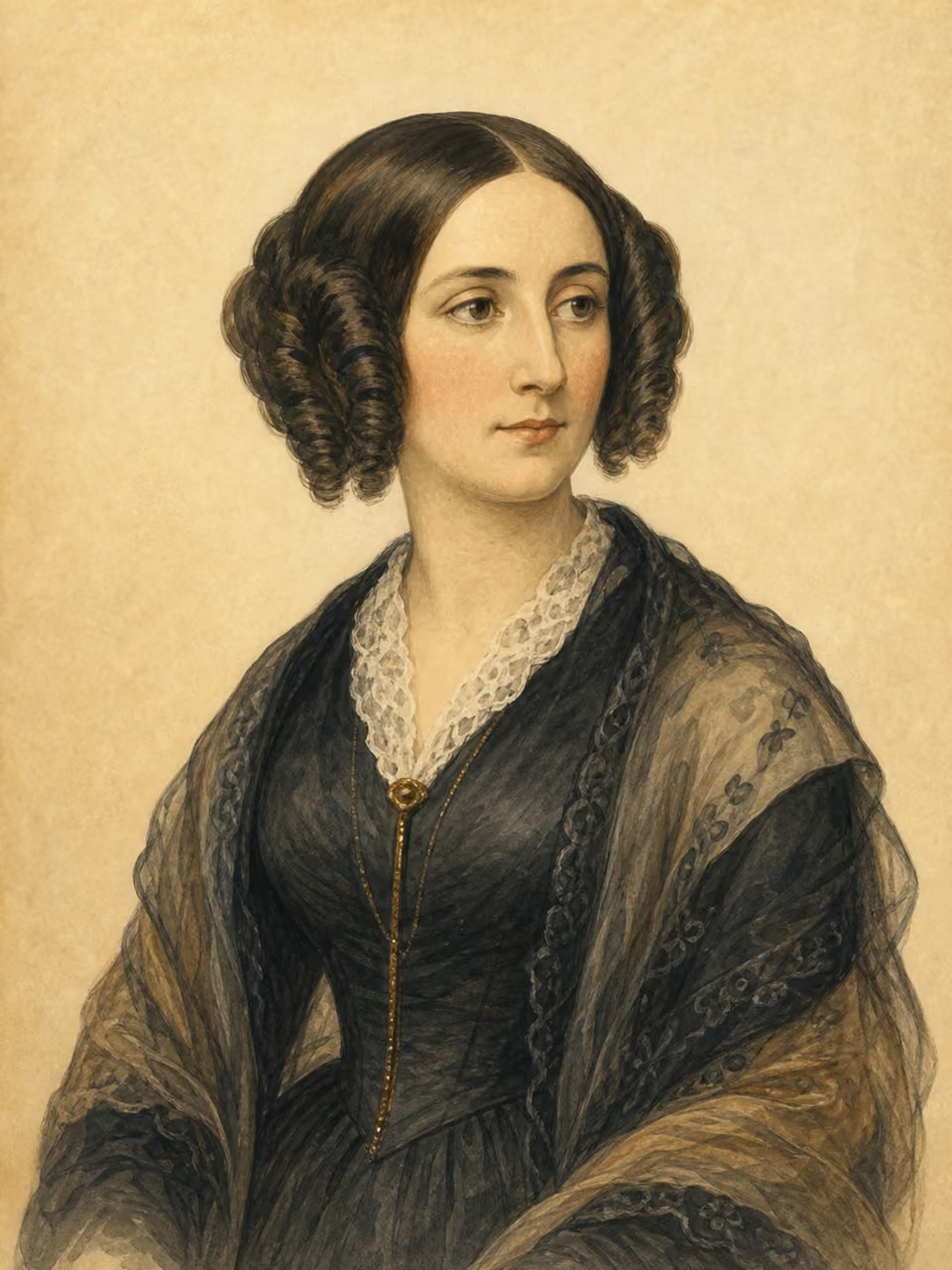
Ada Lovelace

Portrait: AI-generated imagined likeness

Ada Lovelace

Mathematician · Programmer

Years
1815–1852
Birthplace
United Kingdom
Birth polity
United Kingdom of Great Britain and Ireland
Era
Modern
Field
Invention
Occupations
Mathematician · Programmer

When Ada Lovelace encountered Babbage's Analytical Engine, she did more than summarize it for polite readers. In her expanded notes to Menabrea's paper she worked through the machine's operation, outlined a procedure for Bernoulli numbers, and most importantly argued in public that such a device might manipulate symbols beyond ordinary arithmetic.

View in catalog

Historical context

Places

  • London

    Birth

Works & achievements

  • Notes on the Analytical Engine

    1843

    Essay

Origins

Origins map
Birth country
Birth country
United Kingdom

Map: Natural Earth (PD)

Biography

Early life

Ada Lovelace was born in 1815 and received an unusually strong mathematical education for a woman of her social world. Her connection with Charles Babbage brought her into contact with advanced mechanical and mathematical speculation rather than merely polite intellectual culture.

Achievements

Her translation of Luigi Menabrea's account of the Analytical Engine, together with the extensive notes she added, secured her historical place. In Note G she outlined a procedure for calculating Bernoulli numbers, and more broadly she argued that such a machine might manipulate symbols in ways not limited to routine arithmetic.

Character & anecdotes

The exact balance between Lovelace's original insight and the influence of Babbage has long been debated, which sometimes turns discussion into a contest over credit. Yet that very debate underscores how unusual her engagement was: she was trying to imagine what a general-purpose machine could mean, not simply describing hardware.

Historical Impact

Lovelace became important not because a finished computer stood before her, but because she helped imagine what general computation could mean before the machinery existed. Her afterlife in computing culture and in histories of women in science is powerful, yet it also points back to a more concrete achievement: making conceptual room for software-like thinking inside nineteenth-century mathematics and engineering.