
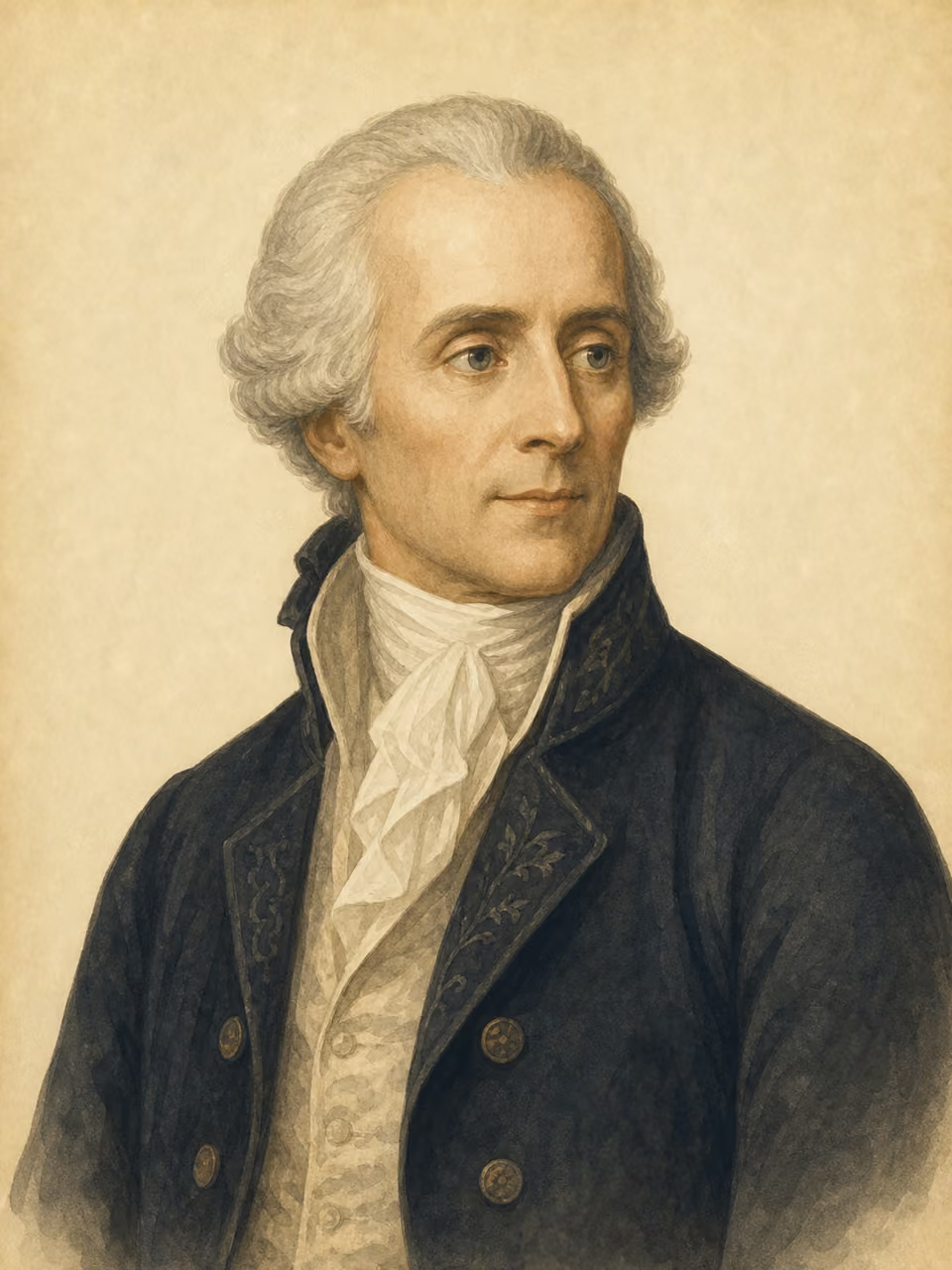
Pierre-Simon Laplace

Portrait: AI-generated imagined likeness

Pierre-Simon Laplace

Mathematician · Astronomer · Physicist · Statistician

Years
1749–1827
Birthplace
France
Birth polity
Kingdom of France
Era
Early modern
Field
Science
Occupations
Mathematician · Astronomer · Physicist · Statistician

A French mathematician and astronomer, and a scientist who systematized celestial mechanics. He is a representative figure of modern science who developed Newtonian mechanics into precise calculations. It provides clues to understanding the changes in knowledge that continued from the Enlightenment period to modern science.

View in catalog

Historical context

Places

  • Beaumont-en-Auge

    Birth

Works & achievements

  • Celestial Mechanics

    1799–1825

    Book

Origins

Origins map
Birth country
Birth country
France

Map: Natural Earth (PD)

Biography

Early life

Born in the Normandy region, he was recognized for his mathematical talent and moved to Paris. He continued his research in pre- and post-revolutionary France, gaining status within academia and the state system.

Achievements

In ``Celestial Mechanics,'' he explained planetary motion mathematically and made important contributions to probability theory. He is also known for his nebular theory regarding the formation of the solar system.

Character & anecdotes

He is famous for the anecdote that he was asked by Napoleon about the place of God, but it better reflects the spirit of the times, which sought to explain natural phenomena using mathematics rather than truth or falsehood.

Historical Impact

Studying Laplace reveals that knowledge after the Scientific Revolution was deepened not only through observation, but also through mathematical formulas, probability, and the national academic system. You can understand the flow from the Enlightenment to modern science through the intersection of astronomy and mathematics.