
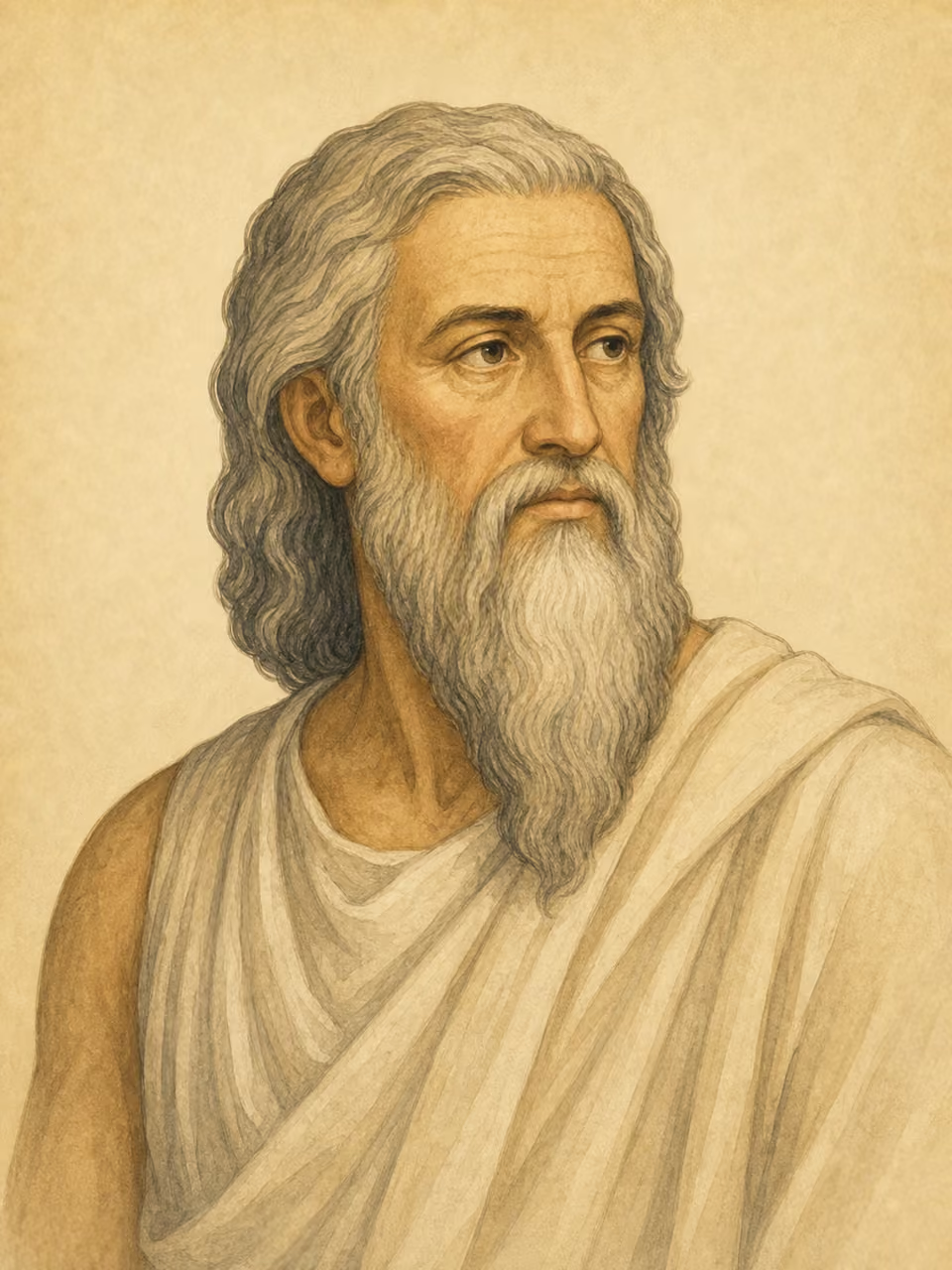
Pythagoras

Portrait: AI-generated imagined likeness

Pythagoras

Philosopher · Mathematician

Years
c. 583 BC–c. 491 BC
Birthplace
Greece
Birth polity
Ancient Greek world
Era
Ancient
Field
Science
Occupations
Philosopher · Mathematician

Known as an ancient Greek mathematician and thinker, he placed numbers at the center of understanding the world. Shows the connections between mathematics, religion, and philosophy through the traditions of the Pythagorean cult. It also conveys that the boundaries of ancient science were still soft.

View in catalog

Historical context

Places

  • Samos

    Birth

  • Croton

    Work

Events

  • Formation of the Pythagorean school

    530 BC–500 BC

    Movement · Leader

Origins

Origins map
Birth countryAssociated countries
Birth country
Greece
Associated countries
Italy

Map: Natural Earth (PD)

Biography

Early life

It is said that he was born on the island of Samos, and after traveling throughout the country, he formed a community in Croton in southern Italy. He is a person with a strong mix of historical fact and legend.

Achievements

Although he is famous for his Pythagorean theorem, it is understood more as a mathematical tradition of the cult than as a direct proof by himself. Interest in pitch ratio and numerical order is also important.

Character & anecdotes

The cult had a code of living and was secretive, and was not just a school but also a religious community. Ancient knowledge existed in a form different from the modern divisions of mathematics, religion, and philosophy.

Historical Impact

By studying Pythagoras, you can understand how Greek thought sought to explain nature in terms of numbers and order rather than myths. At the same time, it becomes clear that ancient science was inseparable from religious practices and communities.