
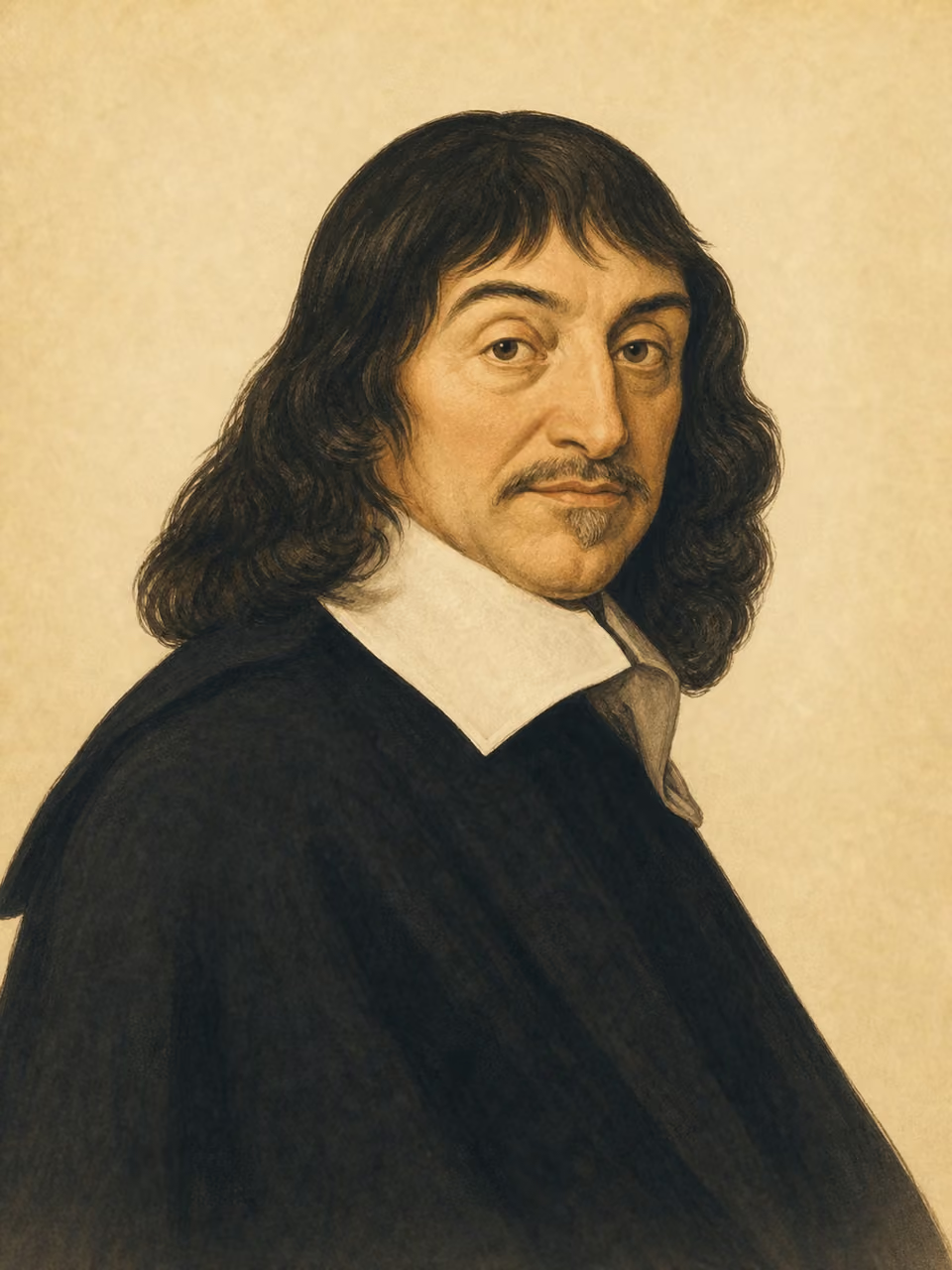
René Descartes

Portrait: AI-generated imagined likeness

René Descartes

Philosopher · Mathematician · Physicist · Writer

Years
1596–1650
Birthplace
France
Birth polity
Kingdom of France
Era
Early modern
Field
Philosophy
Occupations
Philosopher · Mathematician · Physicist · Writer

A philosopher and mathematician representing early modern Europe. Known for his methodological skepticism and analytical geometry, he laid the foundations for modern rationalism and scientific thought. This book will help you understand the intersection between the scientific revolution and modern philosophy.

View in catalog

Historical context

Places

  • La Haye en Touraine

    Birth

  • Netherlands

    Work

Works & achievements

  • Discourse on the Method

    1637

    Book

Origins

Origins map
Birth countryAssociated countries
Birth country
France
Associated countries
Netherlands · Sweden

Map: Natural Earth (PD)

Biography

Early life

Born in France, he studied classics and mathematics at a Jesuit school. After military service and travel, he lived for a long time in the Low Countries in search of a relatively free intellectual environment.

Achievements

In his ``Introduction to Method,'' he shows a method for obtaining reliable knowledge, and is known for his mind-body dualism and ``I think, therefore I am.'' Analytic geometry using coordinates is also important in the history of mathematics.

Character & anecdotes

Descartes was a mathematician as well as a philosopher, and he tried to apply his method of thinking to the study of nature. This shows that early modern scholarship was a wide range of knowledge before specialization.

Historical Impact

If you study Descartes, you will see that modern thought sought to construct knowledge through doubt, method, and reason, rather than through the inheritance of authority. As a person who connects the scientific revolution and the history of philosophy, we can understand the intellectual transformation of early modern Europe.