
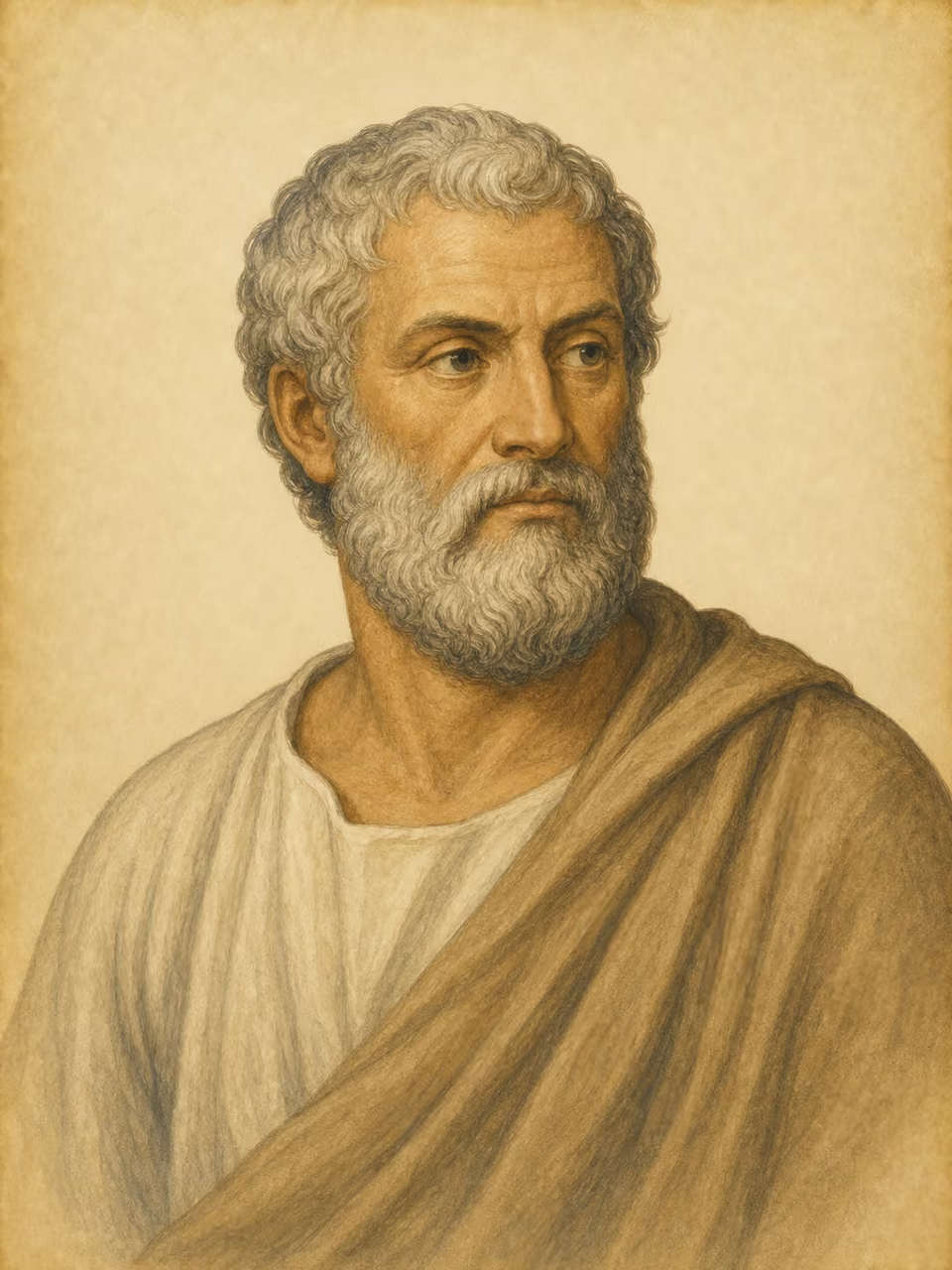
Thales

Portrait: AI-generated imagined likeness

Thales

Philosopher · Mathematician · Astronomer

Years
c. 625 BC–c. 546 BC
Birthplace
Greece
Birth polity
Ionian Greek city
Era
Ancient
Field
Philosophy
Occupations
Philosopher · Mathematician · Astronomer

A thinker from Miletus who is considered the beginning of ancient Greek philosophy. He was a person who tried to explain natural phenomena from principles rather than myths. It is important when considering the origins of philosophy, mathematics, and astronomy.

View in catalog

Historical context

Places

  • Miletus

    Birth

  • Ionia

    Work

Works & achievements

  • Thales' theorem tradition

    Theory

Origins

Origins map
Birth countryAssociated countries
Birth country
Greece
Associated countries
Türkiye

Map: Natural Earth (PD)

Biography

Early life

He was active in Miletus, on the west coast of Asia Minor, and was part of a wide intellectual exchange in Ionia, a trading city. It is said that his contact with Egyptian and Babylonian knowledge was also behind his interest in mathematics and astronomy.

Achievements

He is known for his knowledge of solar eclipse prediction and geometry, as well as the legend that he sought the root of all things in water. Although there are many uncertainties in historical facts, it has become a symbol of an attitude of questioning nature rationally.

Character & anecdotes

There is an anecdote from Thales about a man who fell into a well while looking at the stars. While this is a mockery of philosophers, it is also a story that shows interest in the wisdom of observing the heavens.

Historical Impact

When you study Thales, you can understand how ancient Greece talked about an intellectual shift in thinking about nature as separate from mythology. It is positioned as an entry point not only to the history of philosophy but also to the history of science, and shows an academic perspective that values ​​the way questions are asked.