
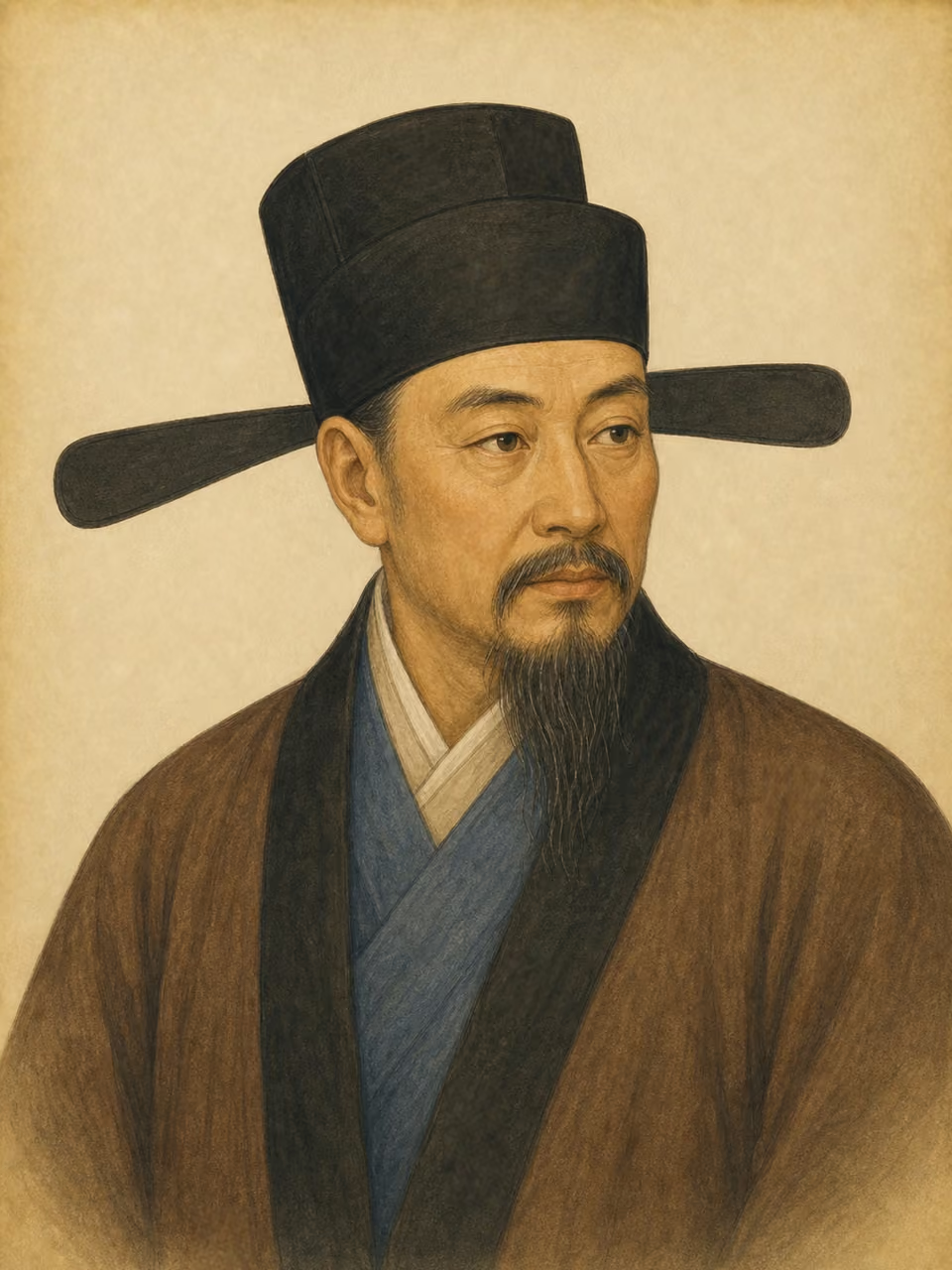
Xu Guangqi

Portrait: AI-generated imagined likeness

Xu Guangqi

Astronomer · Mathematician · translator · Politician

Years
1562–1633
Birthplace
China
Birth polity
Ming dynasty
Era
Early modern
Field
Science
Occupations
Astronomer · Mathematician · translator · Politician

A bureaucrat and scientist at the end of the Ming Dynasty who collaborated with the Jesuit Matteo Ricci. He introduced Western mathematics and astronomy to China, and also became interested in agricultural policy. This is important when considering East-West academic exchange.

View in catalog

Historical context

Places

  • Shanghai

    Birth

  • Beijing

    Work

Works & achievements

  • Chinese translation of Euclid's Elements

    1607

    Book

Origins

Origins map
Birth country
Birth country
China

Map: Natural Earth (PD)

Biography

Early life

Born in Shanghai, he became a bureaucrat after passing the imperial examination. Amid the political crisis at the end of the Ming Dynasty, he became acutely aware of the need to incorporate practical scholarship and Western knowledge.

Achievements

Together with Matteo Ricci, he translated Euclid's ``Elements'' into Chinese, and was also involved in ``Agricultural Policy Complete Works.'' Through calendar reform and the introduction of mathematics, he expanded the worldview of Chinese intellectuals.

Character & anecdotes

Xu Guangqi was also a Chinese intellectual who converted to Christianity. For him, Western scholarship was not just rare knowledge, but also a technology useful for national practice.

Historical Impact

Studying Xu Guangqi reveals that East-West exchanges at the end of the Ming and early Qing periods were not only connected with missionary work, but also with mathematics, the calendar, agriculture, and bureaucracy. Students will be able to concretely understand intellectual exchange in early modern Asia. We can also see the challenges of accepting and translating Western knowledge.