
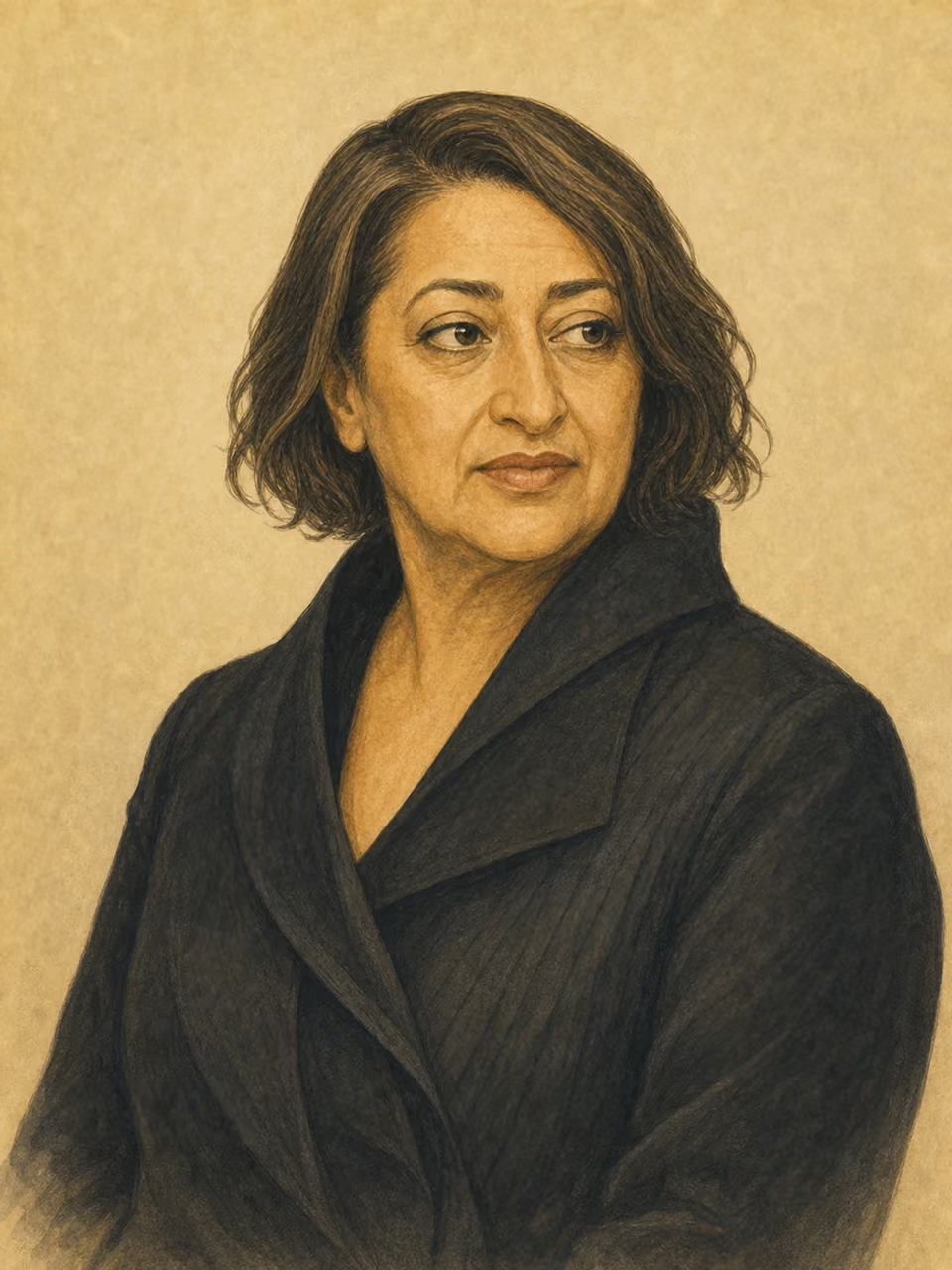
Zaha Hadid

Portrait: AI-generated imagined likeness

Zaha Hadid

Architect

Years
1950–2016
Birthplace
Iraq
Birth polity
Kingdom of Iraq
Era
Contemporary
Field
Art
Occupations
Architect

Zaha Hadid spent years watching critics call her drawings unbuildable before projects such as the Vitra Fire Station and the London Aquatics Centre translated those sharp geometries into concrete urban form. The drama of her career lay in proving that radical paper architecture could become everyday public space.

View in catalog

Historical context

Places

  • Baghdad

    Birth

  • London

    Work

Works & achievements

  • Vitra Fire Station

    1993

    Building

  • Heydar Aliyev Center

    2012

    Building

Origins

Origins map
Birth countryAssociated countries
Birth country
Iraq
Associated countries
United Kingdom

Map: Natural Earth (PD)

Biography

Early life

Zaha Hadid was born in Baghdad in 1950 into an intellectually engaged and internationally oriented family. After studying mathematics, she entered the architectural culture of London, where her increasingly radical design language took shape.

Achievements

She first became widely known through audacious drawings and theoretical projects, then translated that vision into built works such as the Vitra Fire Station, MAXXI, the Guangzhou Opera House, and the London Aquatics Centre. In 2004 she became the first woman to receive the Pritzker Prize on her own, marking a major institutional breakthrough as well.

Character & anecdotes

For years critics treated her as an architect whose ideas looked impossible to build, but advances in design and construction gradually made her spatial concepts feasible on a large scale. Her presentation drawings were not secondary illustrations; they were themselves part of how she reimagined architecture.

Historical Impact

Hadid expanded what contemporary architecture could plausibly look and feel like, while also changing the relationship between drawing, computation, and construction in global practice. Debate around star architecture has never disappeared, but her impact on architectural education and the visibility of women in the profession remains historically significant.

Notes

Her 2004 solo Pritzker Prize win was the first for a woman architect.