
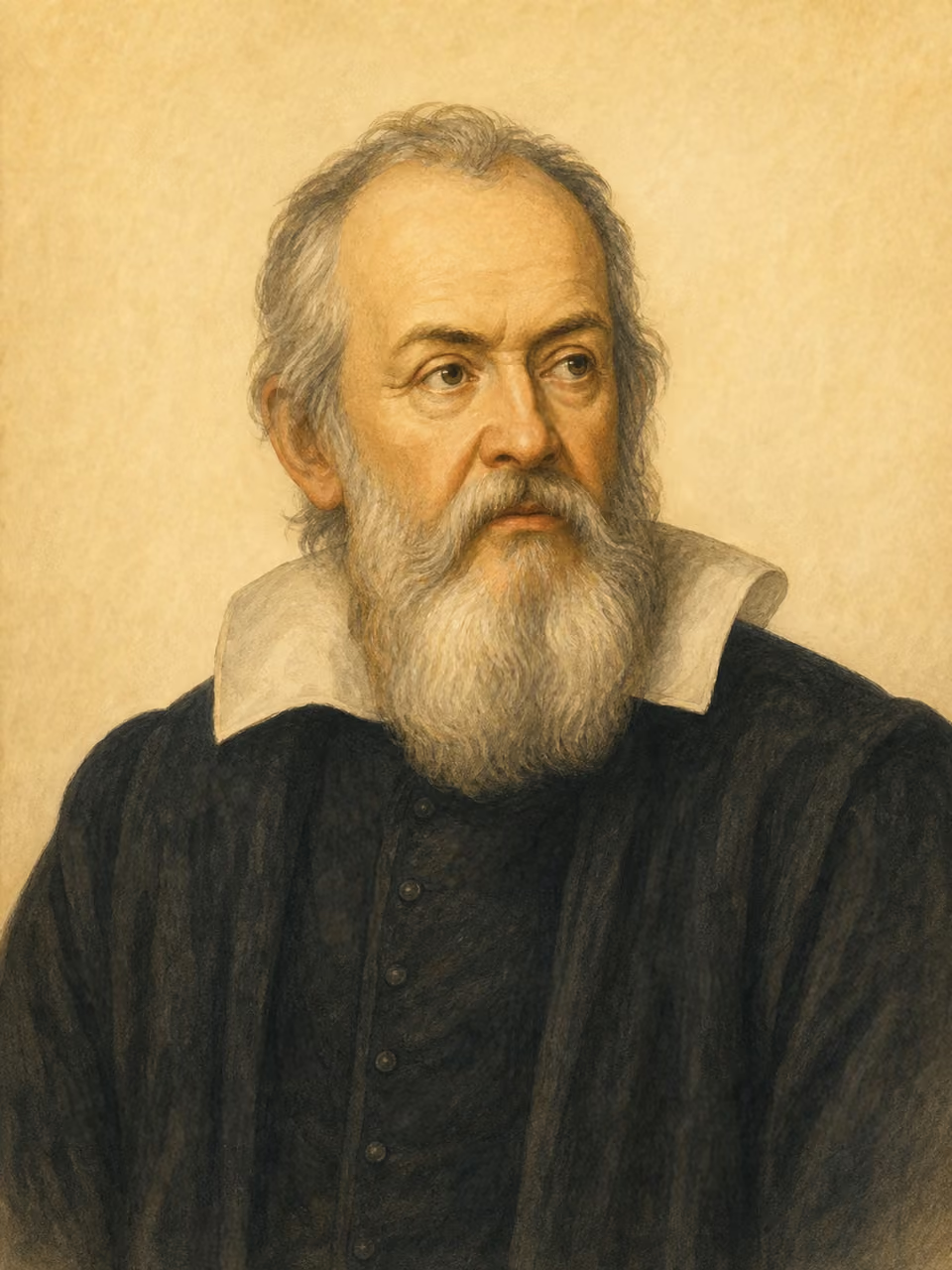
Galileo Galilei

Portrait: AI-generated imagined likeness

Galileo Galilei

Astronomer · Physicist · Mathematician

Years
1564–1642
Birthplace
Italy
Birth polity
Duchy of Florence
Era
Early modern
Field
Science
Occupations
Astronomer · Physicist · Mathematician

Working in Padua where mathematical teaching, instrument craft, and practical problems met, Galileo used an improved telescope to observe the moon, Jupiter's satellites, Venus, and sunspots, unsettling older ideas of a perfect heaven. The later 1633 trial over his defense of heliocentrism made his career into a defining episode in which observation, publication, and institutional authority collided in public view.

View in catalog
Historical context

Places

  • Pisa

    Birth

  • Padua

    Work

Works & achievements

  • Sidereus Nuncius

    1610

    Book

  • Dialogue Concerning the Two Chief World Systems

    1632

    Book

Events

  • Galileo affair

    1633

    Trial · Subject

Origins

Origins map
Birth country
Birth country
Italy

Map: Natural Earth (PD)

Biography

Early life

Born in Pisa in 1564, Galileo first moved toward medicine before turning decisively to mathematics. Teaching at Pisa and then Padua, he worked in a setting where university learning, instrument making, and practical problem solving could reinforce one another.

Achievements

His telescopic observations of the moon, Jupiter's satellites, Venus, and sunspots undermined older assumptions about a perfect and unchanging heaven. In mechanics he pressed toward quantitative explanations of falling bodies and motion, helping turn natural philosophy toward experiment, measure, and mathematical argument.

Character & anecdotes

Galileo's 1633 trial before the Roman Inquisition and the period of house arrest that followed became one of the most famous episodes in the history of science. The story is often simplified, but it genuinely captures how explosive the relation between observation, cosmology, and authority could become.

Historical Impact

Galileo's historical force lies less in a single discovery than in how he helped change the standards of credible knowledge by joining instruments, measurement, experiment, and mathematical argument. The trial has often been simplified into legend, yet it still structures modern memory about the relationship between science, religion, and the power to decide what counts as truth.

Related figures

View all in catalog