
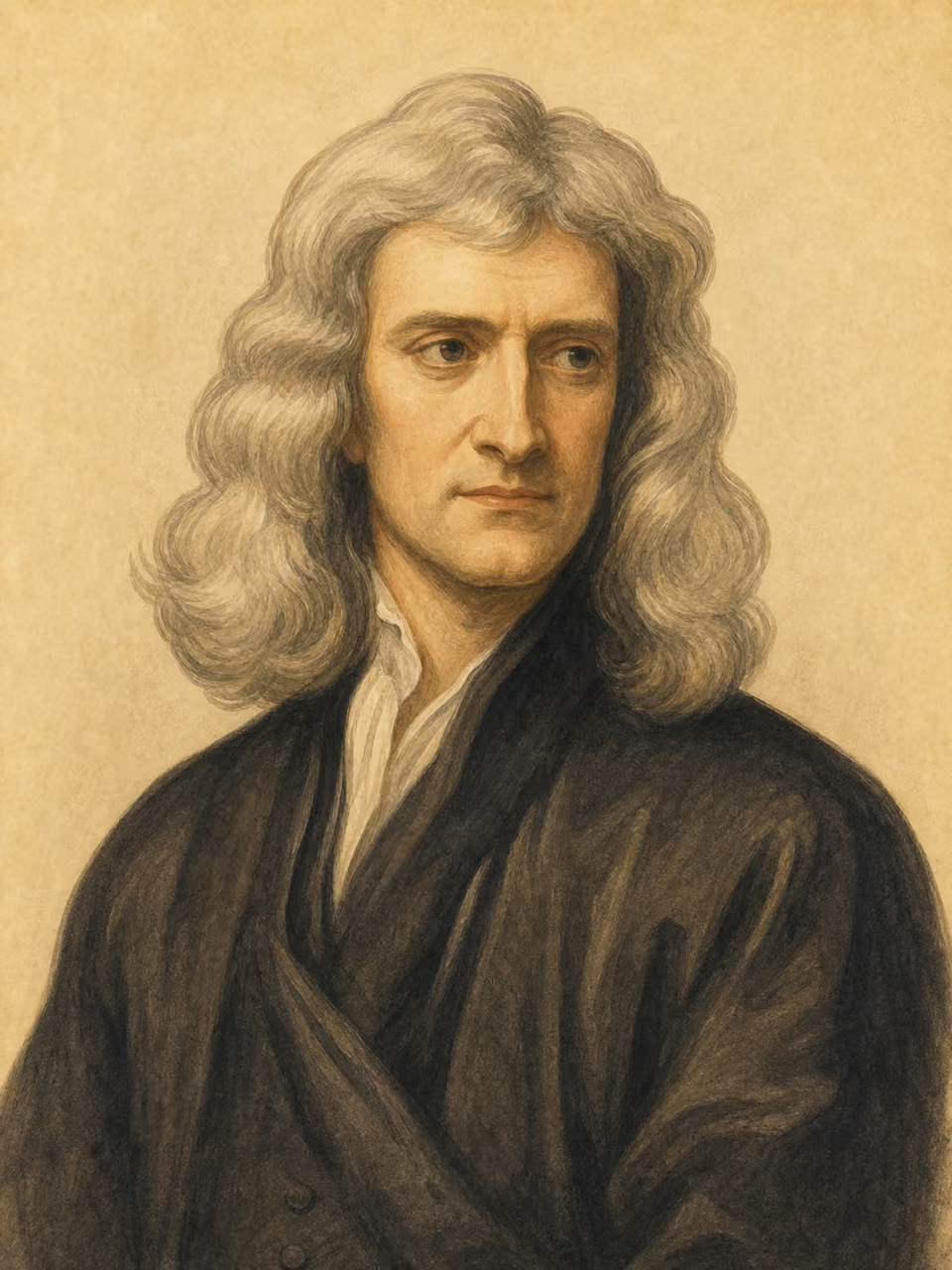
Isaac Newton

Portrait: AI-generated imagined likeness

Isaac Newton

Physicist · Mathematician

Years
1642–1727
Birthplace
United Kingdom
Birth polity
Kingdom of England
Era
Early modern
Field
Science
Occupations
Physicist · Mathematician

During the plague years away from Cambridge, Newton developed lines of thought about light, mathematics, and motion that later converged in the Principia, where terrestrial and celestial movement were bound within one framework. Experiments presented to the Royal Society and later disputes with Hooke and Leibniz turned those ideas into public intellectual battles rather than private inspiration alone.

View in catalog
Historical context

Places

  • Woolsthorpe-by-Colsterworth

    Birth

  • University of Cambridge

    Work

Works & achievements

  • Philosophiae Naturalis Principia Mathematica

    1687

    Book

  • Newton's laws of motion

    1687

    Theory

Origins

Origins map
Birth country
Birth country
United Kingdom

Map: Natural Earth (PD)

Biography

Early life

Isaac Newton was born in 1642 at Woolsthorpe and studied at Cambridge. During the mid-1660s, when plague disrupted university life, he spent crucial time away from campus developing ideas about light, mathematics, and motion that later defined his reputation.

Achievements

In the Principia he united the laws of motion with universal gravitation, showing that terrestrial and celestial movement could be described within one mathematical framework. His work in optics on the composition of white light, together with his role in the development of calculus, broadened that achievement into multiple fields.

Character & anecdotes

Newton could be intensely private and fiercely combative, and his disputes with Robert Hooke and Gottfried Wilhelm Leibniz became famous in their own right. He also spent significant later years at the Royal Mint, where scientific prestige and state service overlapped in unexpected ways.

Historical Impact

Newtonian science became foundational because it offered governments, academies, and teachers a powerful picture of nature as lawful, measurable, and mathematically intelligible. Even after later physics revised his system, the institutions and habits of explanation built under his influence kept Newton at the center of modern scientific memory.

Related figures

View all in catalog