
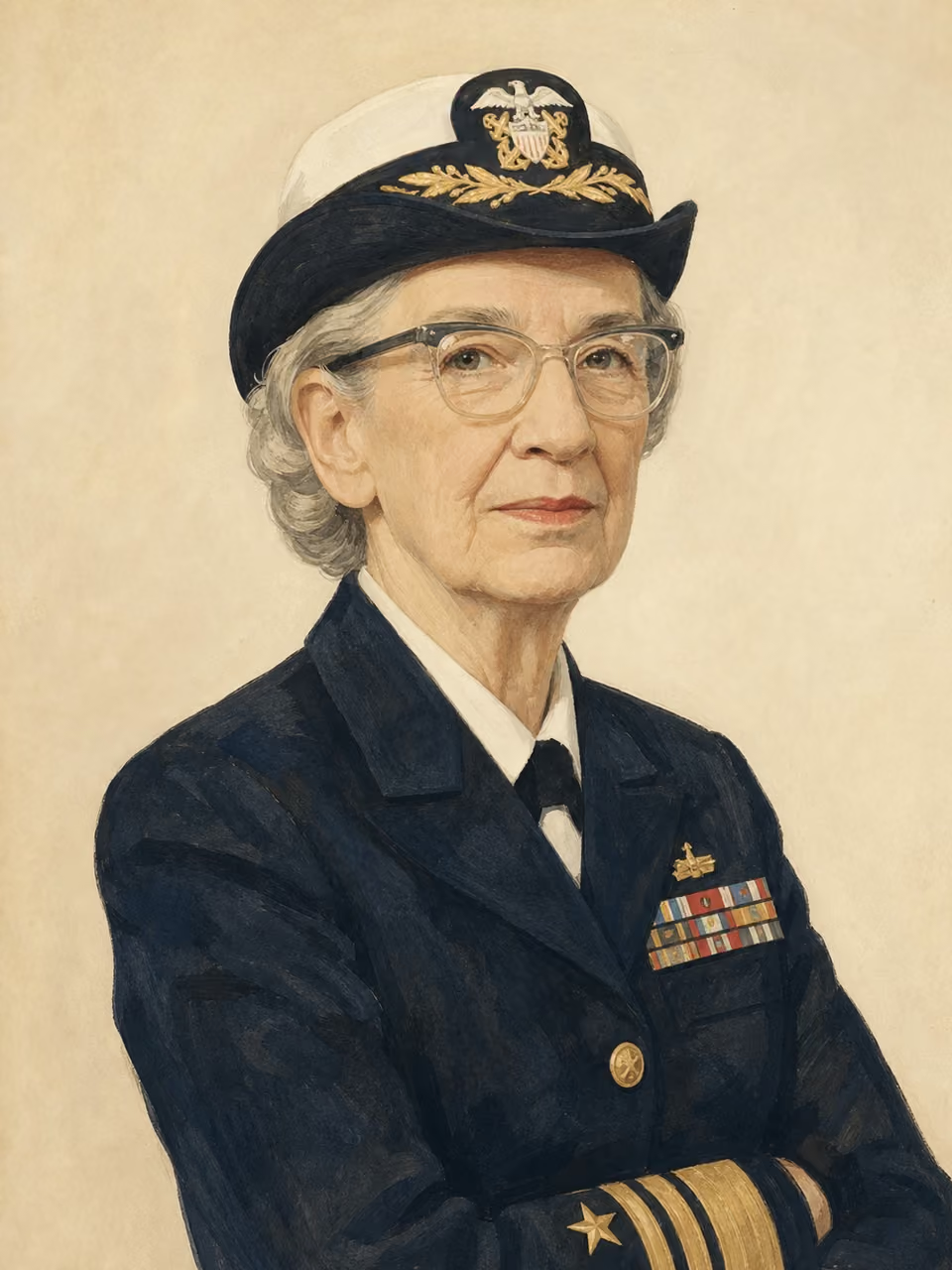
Grace Hopper

Portrait: AI-generated imagined likeness

Grace Hopper

Computer scientist · Mathematician · Programmer · Naval officer

Years
1906–1992
Birthplace
United States
Birth polity
United States
Era
Contemporary
Field
Invention
Occupations
Computer scientist · Mathematician · Programmer · Naval officer

When World War II pulled Grace Hopper from academic mathematics into the Harvard computing project, she helped program the Mark I and explain the machine through one of its earliest major manuals. After the war she pushed toward systems like FLOW-MATIC that let people describe business tasks in something closer to English, widening the horizon of who could work with computers.

View in catalog

Historical context

Places

  • New York City

    Birth

  • Harvard University

    Work

Works & achievements

  • A-0 System

    1952

    Invention

  • COBOL

    1959

    Invention

Origins

Origins map
Birth country
Birth country
United States

Map: Natural Earth (PD)

Biography

Early life

Grace Brewster Murray Hopper was born in New York City in 1906. She studied mathematics and physics at Vassar College and earned master's and doctoral degrees in mathematics from Yale. During World War II she joined the U.S. Naval Reserve and was assigned to the Harvard Mark I computing project.

Achievements

Hopper became one of the first programmers of the Harvard Mark I and wrote a major manual for the machine. After the war she worked on early compilers and programming languages, including FLOW-MATIC, whose business-oriented style influenced the development of COBOL.

Character & anecdotes

In lectures she famously used short lengths of wire to show how far light travels in a nanosecond, turning an abstract computing concept into something audiences could hold. She continued serving in the Navy for decades and ultimately reached the rank of rear admiral.

Historical Impact

Her argument that compilers and higher-level languages could turn computers from specialist machines into organizational tools fed directly into the lineage of COBOL and the later expansion of commercial software. Because she joined that technical influence to a long naval career, she endures not only as a pioneer of programming history but also as a touchstone in how computing education and women in technology remember their past.

Notes

Her nickname, "Amazing Grace," reflects both her public persona and her unusual influence across the Navy and the computing industry.