
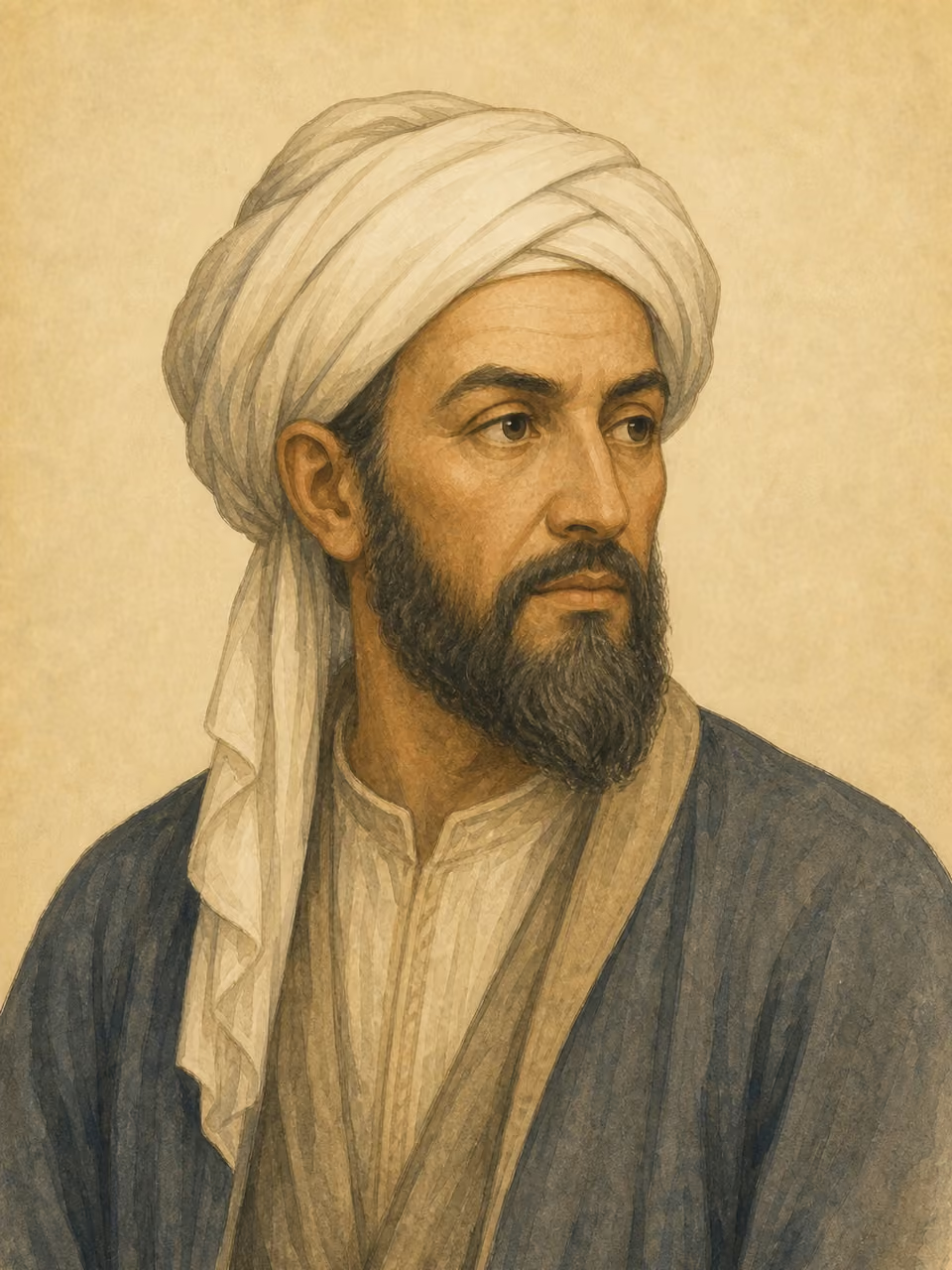
Ibn al-Haytham

Portrait: AI-generated imagined likeness

Ibn al-Haytham

Physicist · Mathematician · Astronomer

Years
965–c. 1040
Birthplace
Iraq
Birth polity
Abbasid Caliphate
Era
Medieval
Field
Science
Occupations
Physicist · Mathematician · Astronomer

Ibn al-Haytham became famous for treating vision not as a mystery of emanation from the eye but as a problem that could be analyzed through light, geometry, and controlled observation. Stories about his retreat after an unrealized Nile engineering scheme only sharpened the image of a scholar working patiently through experiment and argument under pressure.

View in catalog

Historical context

Places

  • Basra

    Birth

  • Cairo

    Work

Works & achievements

  • Book of Optics

    Book

Origins

Origins map
Birth countryAssociated countries
Birth country
Iraq
Associated countries
Egypt

Map: Natural Earth (PD)

Biography

Early life

Born in Basra in the tenth century, Ibn al-Haytham later spent much of his mature life in Egypt. He was trained in mathematics and astronomy and became known less as a court functionary than as a thinker committed to careful observation and argument.

Achievements

In the Book of Optics he argued forcefully that vision depends on light entering the eye, not on rays emitted by it. His investigations of reflection, refraction, image formation, and the camera obscura, together with his insistence on testing claims, made the work foundational for later optics.

Character & anecdotes

A famous story connects him with an unrealized Nile engineering scheme under the Fatimid ruler al-Hakim and with a period of forced seclusion or house arrest. Whether embellished or not, the tale captures how closely his reputation became tied to scholarship produced under pressure.

Historical Impact

The Book of Optics circulated through commentary and translation far beyond its original Arabic setting, deeply affecting later study of vision, light, and image formation. Histories of science repeatedly return to Ibn al-Haytham because his work offered a durable example of how mathematical reasoning, observation, and experiment could be made to check one another.