
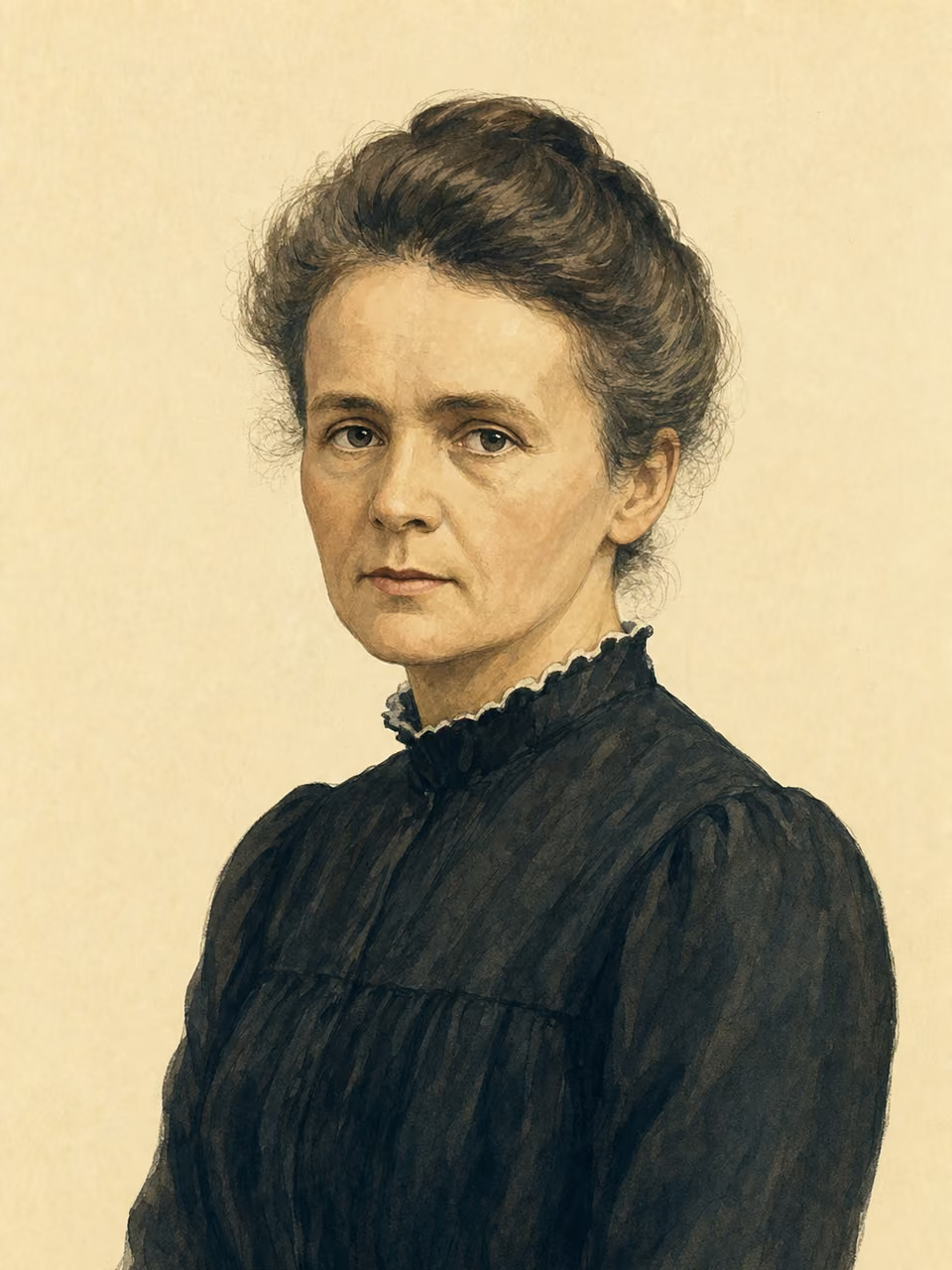
Marie Curie

Portrait: AI-generated imagined likeness

Marie Curie

Physicist · Chemist

Years
1867–1934
Birthplace
Poland
Birth polity
Congress Poland under the Russian Empire
Era
Modern
Field
Science
Occupations
Physicist · Chemist

Working through severe poverty in Paris, Marie Curie and Pierre Curie isolated new elements from painstaking experiments and turned radioactivity into a defined field of research. During World War I she carried that work beyond the laboratory by helping run mobile X-ray units at the front, linking scientific discovery to the emergency care of wounded soldiers.

View in catalog

Historical context

Places

  • Warsaw

    Birth

  • Paris

    Work

Works & achievements

  • Discovery of polonium

    1898

    Discovery

  • Discovery of radium

    1898

    Discovery

Origins

Origins map
Birth countryAssociated countries
Birth country
Poland
Associated countries
France

Map: Natural Earth (PD)

Biography

Early life

Born in Warsaw in 1867 under Russian rule, the youngest child of two teachers. Barred from university as a woman in Poland, she worked as a governess to fund her studies and entered the Sorbonne in Paris in 1891, earning degrees in physics and mathematics despite severe poverty.

Achievements

With her husband Pierre she discovered polonium and radium in 1898 and coined the very term "radioactivity." She won the Nobel Prize in Physics in 1903 and in Chemistry in 1911, became the Sorbonne's first female professor, and founded the Radium Institute, laying the groundwork for radiation medicine.

Character & anecdotes

During World War I she drove mobile X-ray units nicknamed "petites Curies" to the front lines to help diagnose wounded soldiers. She refused to patent the radium isolation process, insisting the discovery belonged to humanity. Her laboratory notebooks remain radioactive to this day and are kept in lead-lined boxes.

Historical Impact

Her discoveries, teaching, and the Radium Institute helped build lasting institutions for radiation medicine, cancer treatment, and nuclear science, reshaping both research and clinical practice in the twentieth century. As the first person to win Nobel Prizes in two different sciences, she also became a durable model for women entering laboratories and universities that had long excluded them, a legacy reinforced by her Panthéon burial and her family's continued scientific prominence.

Notes

Her death in 1934 from aplastic anemia is attributed to decades of radiation exposure. The element curium (Cm) and the radioactivity unit curie (Ci) honor her and Pierre.